| Service functions | |
|---|---|
| Number of charge algorithms (profiles) | 5 |
| Telesignalization |  |
| Power supply mode | |
| Overvoltage protection function | |
| Overheat protection function | |
| Overload (short-circuit) protection function | |
| Current adjustment (discreteness 0.1 A) | |
| Voltage adjustment (0.1 V discreteness) | |
| Operation with BMS (via RS-485) | |
| Technical support during operation | |
Distinctive features
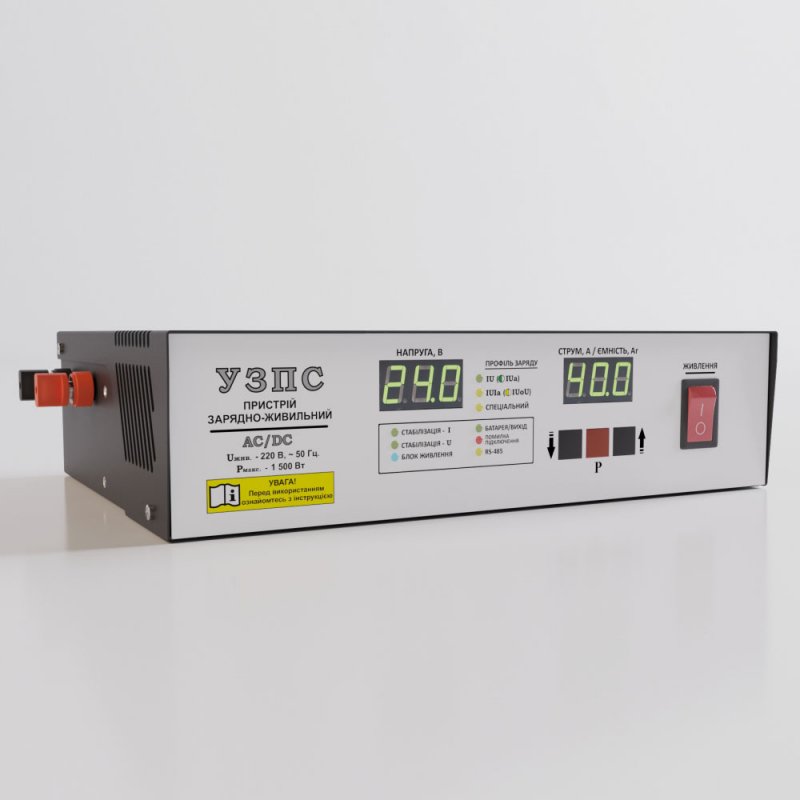
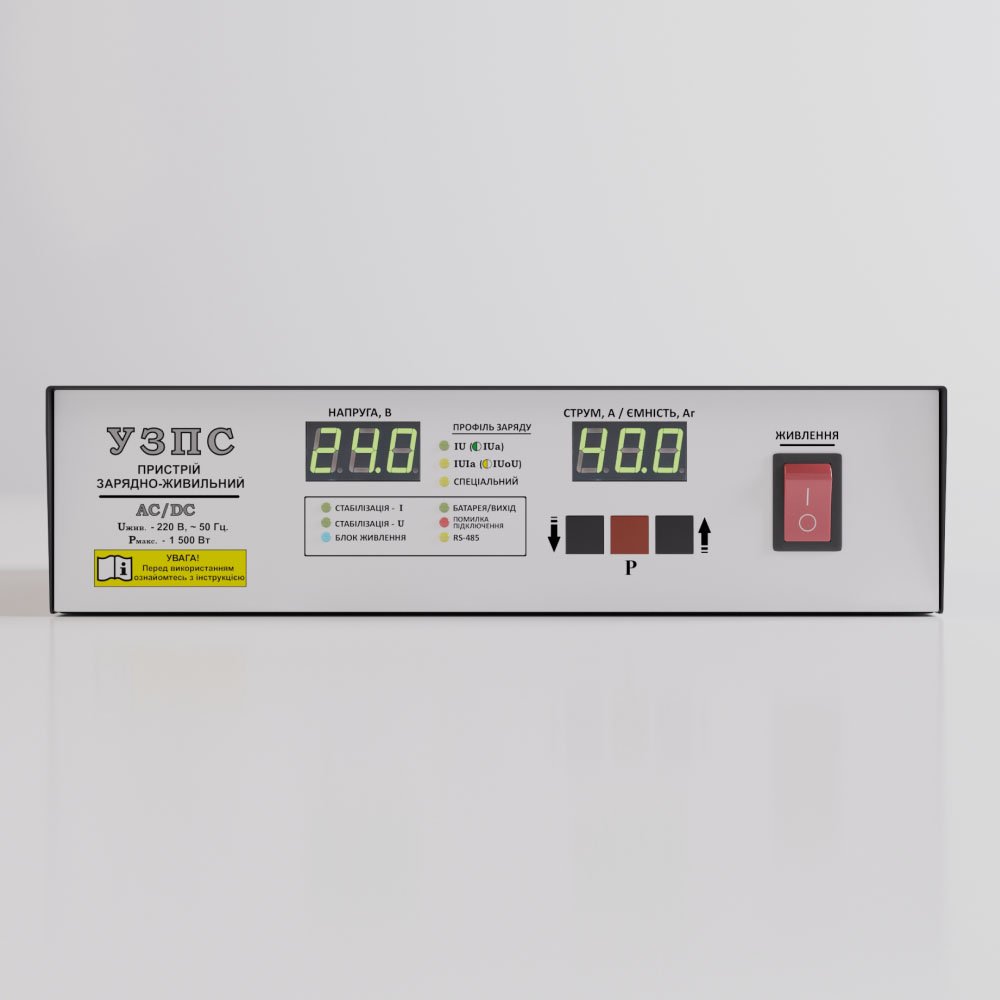
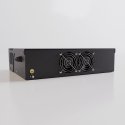
Charger UZPS 24-40 is designed for charging and recharging lead-acid (including gel and AGM) and lithium batteries with nominal voltages of 6, 12 and 24 volts, as well as alkaline batteries with nominal voltages of 6 and 12 volts.
The unit can be used to charge lithium-iron-phosphate (LiFePO4) and lithium-ion (Li-ion) rechargeable batteries with nominal voltages of: 12 and 24 Volts.
A set of charging profiles allows efficient charging of new batteries as well as batteries that have been in service for a long time. Any type of battery can be charged by changing the charging parameters.
| Supported battery types | |||
|---|---|---|---|
| Lead-acid | poured | starter | |
| traction | |
||
| backup | |
||
| AGM | |
||
| (Gel) | |
||
| Alkaline | |
||
| Lithium (Li-Ion, LiFePO4) | |
||
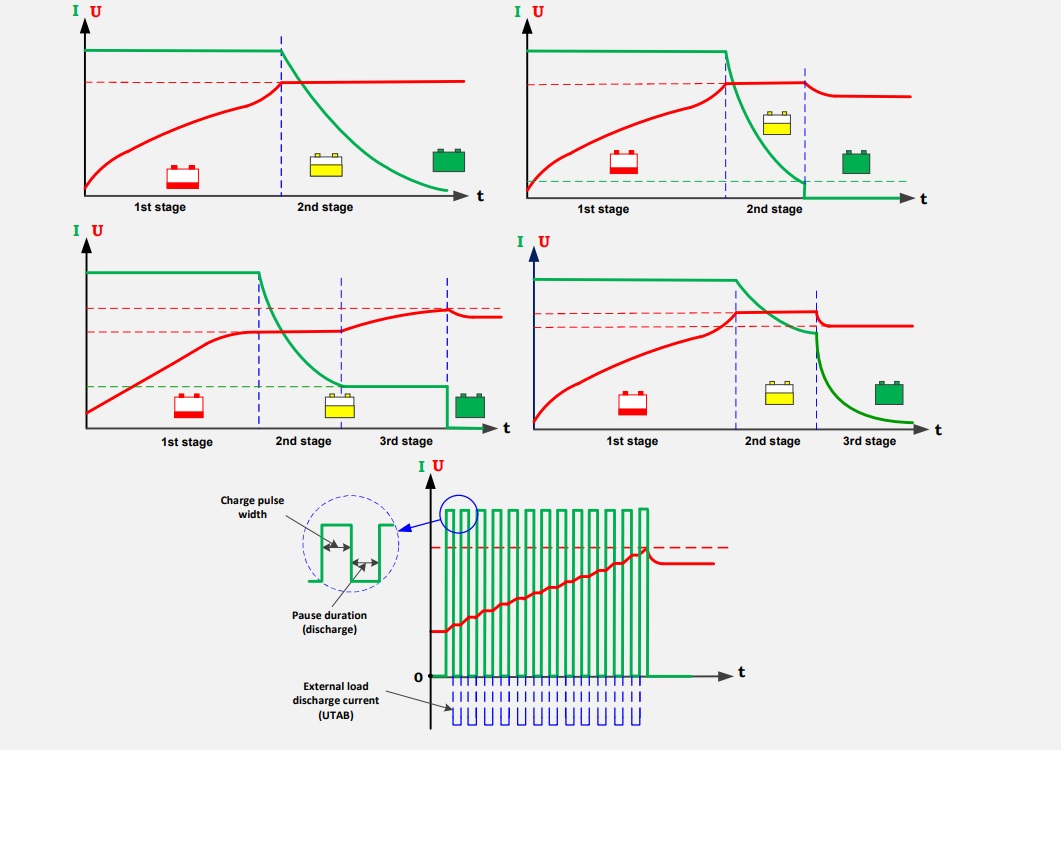
Realizable charge profiles
- Current-limited stabilized voltage charge (buffer mode);
- Stabilized current charge with voltage limitation;
- Two-stage - charge with stabilized current, charge with stabilized voltage "IU - characteristic" (DIN 41 773);
- Three-stage - main charge with stabilized current, additional charge with stabilized voltage, transition to maintenance mode - permanent readiness for operation;
- Maintaining charge (self-discharge current compensation) for batteries that have not been in service for a long time;
- Equalizing charge (elimination of differences in the degree of charge of the cans in the battery);
- Carrying out control and training cycles together with the UTAB 6-48-65 battery testing device;
- Charging with direct current of alternating polarity. - Desulphation, restoration of AB.